
On Wednesday, Egypt’s Ministry of Tourism and Antiquities announced that an Egyptian archaeological mission had uncovered a massive ancient statue at the Tell El-Faraoun site in El-Husseiniya, Sharqia Governorate.
The statue is believed to depict King Ramesses II of Ancient Egypt’s New Kingdom.
Carved from pink granite, it was found missing its lower half, including the legs and base.
Despite its incomplete state, archaeologists say the surviving features clearly point to royal iconography associated with Ramesses II.
 |
| The remains of the statue found at the location "SCA" |
According to the Supreme Council of Antiquities (SCA), the discovery offers new insight into royal and religious life in the eastern Nile Delta.
Initial studies suggest that the statue may not have originally stood at Tell El-Faraoun. Instead, it was likely transported in antiquity from Per-Ramesses—the royal capital during Ramesses II’s reign—to the site, known in ancient times as Imet, where it may have been reused within a religious complex.
 |
| The excavation site at Tell El-Faraoun in Sharkia governorate "SCA" |
I hesitate to say it, but such archaeological announcements have become almost routine in Egypt these days, appearing every few days.
What I did not expect, however, was for this particular discovery to attract widespread attention and go viral—until a report by the Daily Mail the following day reframed the narrative.

The outlet presented the find under its “Science and Tech” section with the headline “Biblical discovery in Egypt as statue linked to story of Moses is found near the Red Sea”. The story's lede and first paragraph with the exact words
“Archaeologists have uncovered part of an ancient statue of a pharaoh in Egypt, who, according to many scholars, is the king mentioned in the biblical story of Moses.
The fragment is thought to depict Ramesses II, one of ancient Egypt's most powerful rulers and a figure many historians associate with the pharaoh described in the Book of Exodus.”
From there, the internet predictably erupted.
The discovery was quickly circulated as “evidence” supporting the historicity of the Exodus and identifying the Pharaoh of Moses.

Even Arab media outlets and social media accounts echoed the Daily Mail’s framing.
مصر...
— إياد الحمود (@Eyaaaad) April 24, 2026
العثور على تمثال فرعوني يُعتقد أنه يجسد فرعون موسى عليه السلام بحسب تأكيدات كثير من الباحثين.
الجزء المكتشف يُجسّد الفرعون "رمسيس الثاني" أحد أقوى حكام مصر القديمة، والذي يربطه كثير من المؤرخين بالفرعون الذي أراد القضاء على نبي الله موسى وقومه.
الاكتشاف كان في موقع "تل… pic.twitter.com/ROtZzbSbV7
“Eyaaaad” is one of the most widely followed unofficial Twitter accounts in Saudi Arabia and across the Gulf.
I’ll take this opportunity to say that, as a Muslim, I believe in the story of Moses and the Exodus. My main source of the story is the Holy Quran and what is mentioned in it.
Worth to say this disclaimer : I am not an Egyptologist , nor I self-claimed armchaird Egyptologist or heavens forbid a religious scholar or Arabic language scholar.
In the Quranic account of these events, the focus is on the moral and spiritual lessons rather than historical specifics.
We are not told the name of the Pharaoh. We are not told the name of the King.
"Pharaoh" is itself not a name — it is a royal title in ancient Egyptian that means "The Great House." It first appeared and came into common use during the New Kingdom, specifically during the 18th Dynasty.
Even "Haman," which some readers assume is a Persian name borrowed from a different historical tradition, is, according to some recent Egyptological findings that are mostly disputed, an ancient Egyptian official title — “H'mn” — referring to the chief of builders and construction overseers. This title was also commonly used during the New Kingdom. We only confirmed this in the 20th century.
In a general sense, Ramesses II — arguably the greatest ruler ancient Egypt ever produced — fits the broad profile of the Exodus Pharaoh at first glance.
 |
| The entrance of Luxor Temple featuring statues of Ramses II and his obelisk Luxor, Egypt, February 2012 |
He was powerful, he was long-reigning, he was a self-declared god-king, and he ruled during the New Kingdom when both the title "Pharaoh" and the title "H'mn" were in common use. But the deeper you dig, the more questions begin to surface.
God alone knows the full truth. But based on the historical record and the findings available to us, I do not think Ramesses II was the Pharaoh of the Exodus.
I am fully aware of how history can be falsified — in modern Egypt as in ancient Egypt. On this question, you will find the argument and its exact opposite, sometimes from the same sources. So let me be transparent about where I am coming from.
I am a Muslim who believes in the story of Moses and the Exodus, primarily according to what is mentioned in the Holy Quran in Classical Arabic. My first native language is Arabic. The first word revealed of the Holy Quran to Prophet Mohamed, peace be upon him, in Mecca was "Read" — and we are commanded not only to read, but to understand.
So let us start from the beginning: the moment the wife of Pharaoh found a Hebrew baby in the River Nile.
This exchange was recorded between her and Pharaoh in Surah Al-Qasas (28:9):
وَقَالَتِ امْرَأَتُ فِرْعَوْنَ قُرَّتُ عَيْنٍ لِّي وَلَكَ ۖ لَا تَقْتُلُوهُ عَسَىٰ أَن يَنفَعَنَا أَوْ نَتَّخِذَهُ وَلَدًا وَهُمْ لَا يَشْعُرُونَ
"And the wife of Pharaoh said, 'A comfort of the eye for me and for you. Do not kill him; perhaps he may benefit us, or we may adopt him as a son.' And they perceived not."
For fourteen centuries, many scholars of this verse have noted that the wife of Pharaoh says, "let him be a son to you and to me."
The Arabic "لَكَ" — to you — implies that Pharaoh had no son of his own to claim, or at least none who filled that emotional space at that time.
She is not saying "he will be a companion to our children." She is proposing adoption as an heir.
Now consider the historical profile of King Ramesses II. He reportedly fathered between 83 and 153 children, making him the most prolific royal father in the recorded history of ancient Egypt.
He had between 48 and 50 sons and between 40 and 53 daughters, born from his Great Royal Wives and a large harem of secondary wives and concubines — all this by the time he died at around 90 years of age after a 66-year reign.
 |
| Children taking photos with the remains of a Ramses II statue at Luxor Temple February 2012 |
He had 8 Great Royal Wives who carried the title of Queen, including his most celebrated wife, Nefertari, as well as two Hittite princesses who were given the honorary title of Great Royal Wife.
Among his 8 Great Royal Wives, at least 4 were his own daughters, elevated to the title after the deaths of their mothers.
Mainstream Egyptologists consider these ceremonial marriages that were never consummated — among them was Princess Meritamen, who inherited her mother Nefertari's title.
Egyptologists also note that none of Ramesses II's daughter-wives appears to have borne children, with perhaps one disputed exception.
In short, King Ramesses II had no need to adopt babies into his palace. He had so many sons that, by the end of his extraordinarily long life, one wonders whether he still remembered all their names.
According to the recorded and verified quotes of Prophet Mohamed, peace be upon him, Pharaoh had at least one daughter — and that daughter had a Hebrew handmaid who sacrificed herself and her children rather than renounce her faith.
Fast-forward to the moment when the tyrannical Pharaoh of Egypt defied the Almighty and claimed to be God.
The Holy Quran records this claim in two places:
سورة النازعات (79:24) فَقَالَ أَنَا رَبُّكُمُ الْأَعْلَىٰ
"And he said: I am your highest lord."
سورة القصص (28:38) وَقَالَ فِرْعَوْنُ يَا أَيُّهَا الْمَلَأُ مَا عَلِمْتُ لَكُم مِّنْ إِلَٰهٍ غَيْرِي فَأَوْقِدْ لِي يَا هَامَانُ عَلَى الطِّينِ فَاجْعَل لِّي صَرْحًا لَّعَلِّي أَطَّلِعُ إِلَىٰ إِلَٰهِ مُوسَىٰ وَإِنِّي لَأَظُنُّهُ مِنَ الْكَاذِبِين
"And Pharaoh said: O chiefs, I know of no god for you other than me. So, kindle for me, O Haman, a fire upon the clay and make me a tower that I may look upon the god of Moses — though I think he is among the liars."
These are not the words of a king who comfortably shares a pantheon with other gods. These are the words of a king making an exclusive, monotheistic-style claim — not "I am the greatest among the gods" but "there is no god for you except me."
A king who speaks this way in that specific, urgent register is a king under pressure. He was losing the theological argument in his own court — his own wife had turned against him; his chief wizards were wavering — and he needed to reassert an authority that was visibly crumbling around him.
Now, Ramesses II is the most popular candidate for the Exodus Pharaoh, partly because he was among the rare ancient Egyptian kings who went beyond the standard divine inheritance and elevated himself into a god with temples dedicated entirely to his own cult — most famously the Abu Simbel complex.
But here is the problem: he never denied the other gods.
He added himself alongside the gods — not instead of them.
At Abu Simbel, he sits with three other gods, “Amun, Ra, and Ptah” — he is fourth in the row, not alone.
Throughout his reign, he worshipped Amun, Ra and Ptah simultaneously and built temples in their honour.
He even famously credited Amun for saving his life at the Battle of Kadesh.
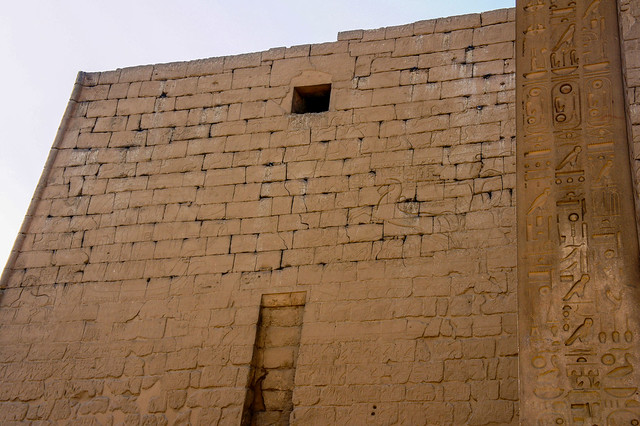 |
| Ramses II Pylon at Egypt's Luxor temple featuring his military campaign and the battle of Kadash, Luxor, Egypt, February 2012 |
A man who publicly thanks Amun for saving him cannot simultaneously claim to be the only god.
To understand why this matters, we need to understand how divine kingship actually worked in ancient Egypt. Every Pharaoh from the Early Dynastic Period onward was considered divine by default — it was not a personal claim; it was the job description.
Every king was the son of Ra, the living incarnation of Horus, and upon death, he became Osiris. He was the mediator between the gods and humanity. This was institutional theology, not personal arrogance.
Some kings, however, went further and elevated themselves into full gods within the Egyptian pantheon during their own lifetimes.
This began, as far as we know, with Khufu of the Fourth Dynasty of the Old Kingdom — yes, the very Khufu who built the Great Pyramid of Giza.
To the epic end of a tyranny — a king who defied the Almighty met his end in the most dramatic fashion history has ever recorded.
Pharaoh drowned as he witnessed the greatest miracle of all time: a sea split into two walls of water to allow thousands of fleeing people to cross, while his vast army bore down upon them. The king himself rode at the head of his forces on his chariot, consumed by rage, certain of victory. Then the sea closed.
The tyrant drowned, and with him every soldier of his army and every one of his supporters.
That miracle was immortalized in six verses in the Holy Quran.
Surah Al-Baqarah (2:50) وَإِذْ فَرَقْنَا بِكُمُ الْبَحْرَ فَأَنجَيْنَاكُمْ وَأَغْرَقْنَا آلَ فِرْعَوْنَ وَأَنتُمْ تَنظُرُونَ
"And when We parted the sea for you and saved you, and drowned the people of Pharaoh while you watched."
Surah Al-A'raf (7:136) فَانتَقَمْنَا مِنْهُمْ فَأَغْرَقْنَاهُمْ فِي الْيَمِّ بِأَنَّهُمْ كَذَّبُوا بِآيَاتِنَا وَكَانُوا عَنْهَا غَافِلِينَ
"So We took retribution from them and drowned them in the sea, because they denied Our signs and were heedless of them."
Surah Yunus (10:90) وَجَاوَزْنَا بِبَنِي إِسْرَائِيلَ الْبَحْرَ فَأَتْبَعَهُمْ فِرْعَوْنُ وَجُنُودُهُ بَغْيًا وَعَدْوًا ۖ حَتَّىٰ إِذَا أَدْرَكَهُ الْغَرَقُ قَالَ آمَنتُ أَنَّهُ لَا إِلَٰهَ إِلَّا الَّذِي آمَنَتْ بِهِ بَنُو إِسْرَائِيلَ وَأَنَا مِنَ الْمُسْلِمِينَ
"And We brought the Children of Israel across the sea, and Pharaoh and his soldiers pursued them in transgression and aggression. Until, when drowning overtook him, he said: I believe that there is no god except the One in whom the Children of Israel believe, and I am of those who submit."
Surah Ash-Shu'ara (26:66) فَأَغْرَقْنَا الْآخَرِينَ
"And We drowned the others."
Surah Ad-Dukhan (44:24) وَاتْرُكِ الْبَحْرَ رَهْوًا ۖ إِنَّهُمْ جُندٌ مُّغْرَقُونَ
"And leave the sea parted and still. They are an army that shall be drowned."
When I read these verses carefully, I am not reading about a military defeat — as complete and catastrophic as that defeat was. I am reading about something far larger: the sudden and total erasure of a ruling dynasty through the death of its king, his army, his court and his people, all at once.
We do not know whether that Pharaoh had an heir waiting in his palace. But we know that he, his army, his supporters and his inner circle were all drowned together.
Whoever inherited the throne of Egypt that day inherited it without an army, without the experienced commanders and ministers of the previous reign, and without the institutional power that had kept that dynasty in place.
In ancient Egyptian terms, that is not a transition of power — that is the beginning of an intermediary period of chaos, waiting for some general, priest or provincial prince to step forward and fill the void.
This is precisely what did not happen after the death of Ramesses II.
Ramesses II died at approximately 90 years of age, and Egypt did not flinch.
The throne passed smoothly to his son Merneptah, already around 60 years old and an experienced military commander in his own right, who went on to maintain Egypt's dominance across the Near East.
 |
| King Merenptah Cartouche on his father's statue at the Egyptian Museum of Cairo December 2015 |
You do not project that kind of military and political power with an army built from scratch. Egypt after Ramesses II was still Egypt at the height of the New Kingdom — confident, organized and imperial.
There is much more to say about Merneptah, because like his father, he is deeply entangled in the Exodus debate — but that deserves its own post.
One more thing worth noting: Ramesses II was nearly 90 years old when he died, crippled by arthritis in his hips and spine after decades of campaigning. The image of this man personally leading a chariot charge across the desert floor in pursuit of the Israelites would itself require a miracle.
The Almighty then decreed something unprecedented — that the body of this king would be preserved and displayed until the end of time, as a sign and a lesson for all who came after.
Surah Yunus (10:92) فَالْيَوْمَ نُنَجِّيكَ بِبَدَنِكَ لِتَكُونَ لِمَنْ خَلْفَكَ آيَةً ۚ وَإِنَّ كَثِيرًا مِّنَ النَّاسِ عَنْ آيَاتِنَا لَغَافِلُونَ
"So today We shall preserve your body, so that you may be a sign for those who come after you. And indeed, many people are heedless of Our signs."
This verse is perhaps the most cited piece of evidence connecting Ramesses II to the Exodus — by Muslims and Egyptians alike — because of his remarkably well-preserved mummy. And it is true: his mummy is a sign, in the literal sense the verse describes. But here is the thing: he is not alone. There are nearly thirty confirmed royal mummies from ancient Egypt, the majority of them from the New Kingdom, the same era most Exodus theories point to. The Pharaoh of Moses could be any one of them. We simply do not know.
But just like everything in the story of Ramesses II, there is a counterpoint — and this one came from Paris.
In the 1970s, the mummy of Ramesses II was deteriorating seriously in the Egyptian Museum in Cairo.
Egyptian authorities made the remarkable decision to send it with a diplomatic passport to France for conservation treatment.
.jpg "Ramses II diplomatic passport") |
| The only deceased King in the world who got a diplomatic passport that identified him as a King |
In September 1976, the mummy of Ramesses II flew to Paris and was received at Le Bourget airport with full head-of-state honours, including a military guard of honour. France extended to a 3,000-year-old mummy the same protocol reserved for visiting kings.
A multidisciplinary team at the Musée de l'Homme conducted the most thorough examination the mummy had ever received and produced a detailed report on his condition at the time of death.
 |
The mummy of Ramses II at the Musée de l'Homme in Paris in 1976, AFP Colored by Google Banana Nano |
He died at an estimated age of approximately 90 years, based on bone density, dental wear and other physical markers.
There was no single definitive cause of death — the consensus pointed to accumulated old-age deterioration, with severe dental abscesses and cardiovascular disease as the primary contributors.
He suffered from severe arthritis, particularly in the hips and spine, consistent with decades spent on horseback and on military campaigns. Atherosclerosis — hardening of the arteries — was confirmed through examination of the arterial tissue, alongside evidence of poor circulation in his final years.
The mummy showed no signs of drowning.
After 3,000 years, water in the lungs was never going to be detectable. But the physical condition of the body and the manner of its preservation were entirely consistent with a man who died of natural causes and was then embalmed through the standard Egyptian royal funerary process.
He was mummified properly, buried properly, and his tomb in the Valley of the Kings — KV7 — had been prepared in advance, as was the custom for Egyptian kings.
In 2023, a new study using CT scanning and advanced imaging confirmed and expanded the French findings, adding further detail about his spinal deterioration and arterial disease.
The picture that emerges is of a man who lived an extraordinarily long and physically punishing life and simply wore out — which is about as far from drowning in pursuit of escaping people as it is possible to imagine.
I will stop here, and God willing, the next post in this series will examine the Hebrew timeline as recorded in the Hebrew Bible — and what happens when you try to map it onto the verified chronology of ancient Egypt.
As you can see, when approached from an Islamic perspective, the evidence consistently points away from Ramesses II rather than toward him.
The Holy Quran never mentions his name — unlike the Hebrew Bible — and I believe that is not an oversight.
It is the core of the matter.
I believe, as a Muslim, that the Exodus happened. And I believe its lessons are more important than knowing the name of the Pharaoh. We do not know the name of the ancient Mesopotamian king who defied Prophet Abraham, peace be upon him — and yet we believe completely that Abraham stood against that tyrannical king in what may have been the first recorded confrontation between monotheism and the arrogance of absolute power in the ancient world.
The reason I find myself provoked enough to write pieces this long is the political weaponization of this story — by the same Western establishment that publicly rejects creationism and embraces Darwinism, yet has no difficulty deploying religious narratives when they serve a contemporary political purpose.
That contradiction deserves far more scrutiny than it receives.
No comments:
Post a Comment
Thank You for your comment
Please keep it civilized here, racist and hateful comments are not accepted
The Comments in this blog with exclusion of the blog's owner does not represent the views of the blog's owner.