Showing posts with label Archeology. Show all posts

Saturday, April 25, 2026

The Land of Abraham and Sons: Why Ramesses II can not be and can be “the pharaoh of exodus”- Islamic Edition

On Wednesday, Egypt’s Ministry of Tourism and Antiquities announced that an Egyptian archaeological mission had uncovered a massive ancient statue at the Tell El-Faraoun site in El-Husseiniya, Sharqia Governorate.

The statue is believed to depict King Ramesses II of Ancient Egypt’s New Kingdom.

Carved from pink granite, it was found missing its lower half, including the legs and base.

Despite its incomplete state, archaeologists say the surviving features clearly point to royal iconography associated with Ramesses II.

The remains of the statue found at the location  "SCA"
The remains of the statue found at the location 
"SCA"

According to the Supreme Council of Antiquities (SCA), the discovery offers new insight into royal and religious life in the eastern Nile Delta. 

Initial studies suggest that the statue may not have originally stood at Tell El-Faraoun. Instead, it was likely transported in antiquity from Per-Ramesses—the royal capital during Ramesses II’s reign—to the site, known in ancient times as Imet, where it may have been reused within a religious complex.

The excavation site at Tell El-Faraoun in Sharkia governorate  "SCA"
The excavation site at Tell El-Faraoun in Sharkia governorate
 "SCA"

I hesitate to say it, but such archaeological announcements have become almost routine in Egypt these days, appearing every few days. 

What I did not expect, however, was for this particular discovery to attract widespread attention and go viral—until a report by the Daily Mail the following day reframed the narrative.

Thursday, February 26, 2026

Ramadan Arabian Nights 2026: The Tale of King al-Nu’man “The Daughter of Kanaan Ep.2”

Ramadan Kareem to all Egyptian Chronicles readers.

Before we continue our tale and learn the fate of Princess Atrashan, it is time for our quick chitchat.

Unlike other tales, King al-Nu’man got names and places inspired by real names and places, especially in Pre-Islamic times.

Starting with King Kanaan, Atrashan’s father, it is a good introduction to speak about the land of Canaan.

Kanaan is the Arabic version of Canaan, and it is associated in Egypt with the Levantines as a name popularly till this day, and it is not a coincidence at all.

Starting with King Kanaan, Atrashan’s father, this serves as a good introduction to speaking about the land of Canaan.

Kanaan is the Arabic form of Canaan, and, in Egypt, the name has long been associated with Levantines — a connection that persists even today, and it is no coincidence.

The first known historical appearance of the name Canaan (or Kanaan) was in ancient Egyptian sources during the New Kingdom of Egypt, beginning in the 15th century BCE.

The term — written in Egyptian hieroglyphs as something like kꜣ-n-ʿ-n — appears in inscriptions referring to a region in the Levant.

Tuesday, October 7, 2025

Egyptian X-Files : Keep an eye out for the missing Khentika limestone relief from Saqqara “Updated”

Egypt’s Public Prosecution has officially launched an investigation into the disappearance of a limestone relief from the world-famous Saqqara necropolis.

The Giza Public Prosecution opened the probe into the missing relief on Monday from the ancient tomb of Vizier Khentika, two days after the Ministry of Tourism and Antiquities confirmed the incident.

The prosecution has instructed security authorities to conduct urgent investigations to uncover the full circumstances of the theft.

All personnel responsible for securing the tomb of Khentika, along with officials from the Ministry of Tourism and Antiquities, have been summoned for questioning. Surveillance footage from the surrounding area will be seized and reviewed, with a detailed report to follow.

The tomb of Khentika

Khentika—also written Khenti-Ka or Ḫenti-ka Ikhekhi—was a high-ranking vizier and priest of the goddess Maat during Egypt’s Sixth Dynasty of the Old Kingdom, serving under Pharaoh Teti. He also held the title of “Overseer of the Royal Palace.”

His mastaba was first uncovered in 1942 by the Egyptian Antiquities Service during the Saqqara survey led by Egyptian Egyptologist Abdel-Salam Hussein, near the pyramid of Teti. Although recorded, the chambers were left sealed due to structural instability and wartime conditions. The tomb remained closed until 1953, when British Egyptologist T. G. H. James completed its excavation and publication.

The tomb is renowned for its detailed wall reliefs depicting scenes of daily life in ancient Egypt—especially those illustrating the authority and activities of its owner, Vizier Khentika.

The disappeared relief from the tomb "Khantika Paints the season" 
From Harvad archives 

The stolen relief—known as the Seasons Relief—is among the original depictions from the tomb of Vizier Khentika.

Thursday, September 18, 2025

Egyptian X-Files: King Amenemope’s stolen bracelet or a theft at the Egyptian Museum of Cairo

It began with a Facebook post claiming a theft at the Egyptian Museum in Cairo and ended with an official statement from the Ministry of Interior announcing the arrest of thieves who stole and melted a 3,000-year-old ancient Egyptian bracelet. And just like that, a classic Egyptian X-File was born.

Early Monday, September 15th, a post by one of Egypt’s heritage activists went viral on Facebook, and it said the following :

Well-informed sources in Egypt’s antiquities sector have disclosed a troubling incident at the Egyptian Museum in Tahrir Square. Just two days ago “Friday 13th”, during the packing and preparation of artifacts bound for Italy’s Treasures of the Pharaohs exhibition at Rome’s Scuderie del Quirinale (October 24 to May 3), staff discovered that one piece was missing: an ancient Egyptian bracelet.

The disappearance came to light during a final inventory check in the conservation lab, when the artifacts were being matched against the official lists.

Authorities immediately sealed the lab, held those present for questioning, and notified the public prosecutor. Tourism and Antiquities Police, along with officers from Cairo’s Qasr al-Nil district, secured the premises.

Phones belonging to employees were confiscated, and the conservation workshop itself was sealed pending further investigation.

While some staff were released after initial questioning, others remain under scrutiny as officials review surveillance footage to trace how the bracelet vanished—just days before the priceless collection was due to travel abroad.

Within a few hours, Egypt’s tabloid news websites not only confirmed the incident but also claimed that the stolen piece was a remarkable bracelet belonging to King Psusennes I.

Thursday, September 11, 2025

Days at the Egyptian Museum of Cairo : The Canopus Decree Stela “Happy Egyptian New Year 6266, Happy Coptic New Year 1741”

Happy Egyptian New Year 6267, Happy Coptic New Year 1742

Today, 11 September, marks “1 Tut,” the first day of the Ancient Egyptian Year 6267, according to the ancient Egyptian calendar.

It is also the first day of the Coptic Year 1742 AM.

Tut refers to Thoth, in case you do not know "Thoth by Midjourney"

As I do every year, I’ll repeat the reminder that the Ancient Egyptian/Coptic New Year begins on 1 Tut, which usually falls on 11 or 12 September in the Gregorian calendar. This calendar continues to be used in Egypt today to determine the dates of religious feasts—particularly in the Coptic Church—and to mark the agricultural seasons.

On this occasion, I’d like to share a unique and monumental piece at the Egyptian Museum in Cairo: the great limestone stela of the Canopus Decree in honor of Ptolemy III.

The Canopus Decree in honor of Ptolemy III at the Egyptian Museum of Cairo مرسوم كانوب في تكريم بطلميوس الثالث في المتحف المصري بالتحرير
The Canopus Decree in honor of Ptolemy III at the Egyptian Museum of Cairo

The Canopus Decree is a trilingual inscription—carved in hieroglyphs, Demotic, and Greek—and stands as the second-earliest example of such trilingual decrees.

The most famous of these, of course, is the Rosetta Stone (which, needless to say, should return to Rosetta, Egypt).

The decree commemorates a grand assembly of priests held at the city of Canopus, on the outskirts of modern Alexandria, to honor Ptolemy III Euergetes of the Ptolemaic dynasty, along with his wife Queen Berenice and Princess Berenice.

Friday, August 15, 2025

Days at the Egyptian Museum of Cairo: Hapi of the Nile Flood

Today, Egypt is officially celebrating Wafaa al-Nil or the Nile Loyalty Festival.

If you think this is a newly invented holiday, think again. Wafaa al-Nil is one of the oldest festivals still celebrated in Egypt today, alongside Sham El-Nassim. In fact, it is among the country’s most ancient traditions—dating back over 7,000 years.

Hapi and the River Nile generated by Sora
Hapi and the River Nile generated by Sora 

The ancient Egyptians linked the festival to the annual inundation of the Nile, which typically began in mid-July and peaked between mid-August and early September. 

The date most often associated with it is August 15, when the floodwaters became clearly visible in Memphis (and later Cairo). The exact timing, however, depended on rainfall in Ethiopia.

Historical evidence traces the festival back as far as the Old Kingdom (c. 2686–2181 BCE), with inscriptions and temple reliefs depicting rituals dedicated to Hapi, the god of the Nile’s flood.

On this occasion, I’m sharing a couple of photos of Hapi from the Egyptian Museum in Cairo.

Saturday, July 26, 2025

Egyptian X-Files : Tut’s Grasshopper, the Qatari Prince and Apollo "‘Updated"

It won’t be the first time, nor will it be the last—but raising awareness is still worthwhile.

On 27 July at 1 PM GMT, the Apollo Art Auctions showroom in Central London will host the second day of a unique and highly controversial auction, both in person and online.

The sale features ancient artefacts from a private collection long associated with the shadowy world of the underground antiquities market.

The first day of the auction, held on 26 July at 1 PM GMT, showcased artefacts from Medieval, Asian, South American, and Western Asiatic cultures. But the second day is the real centerpiece.

On both days, a total of 953 lots to be auctioned. Day 1 included 434 lots while Day 2 included 519 lots.

Out of the total 894 lots, 297 lots are from ancient Egypt, making it the largest representation among all civilizations and cultures covered in the auction. The overall average starting price of Ancient Egyptian artefacts is £4,00.

This is a controversial auction by all accounts, focusing on a selection of ancient artefacts from the Prince Collection—described in Apollo’s catalogue as “a private collection assembled over many years, with attention to historical context, craftsmanship, and provenance.”

The auction brochure emphasizes that the second day’s lots represent a “thoughtfully selected” group of antiquities from the Egyptian, Greek, and Roman worlds, with particular focus on “the lasting cultural impact of ancient Egypt.”

The crown jewel of the auctioned Prince Collection is Lot 112—listed as Lot 462 in the Apollo Art Auction.

According to the auction’s brochure, lot 462 is “Egyptian Ivory and Wood Cosmetic Vessel in the Form of a Grasshopper, believed to be (among the known and potential strays from the tomb of Tutankhamun), and once part of the collection of the late Howard Carter.”

The alleged King Tut's grasshopper
The alleged King Tut's grasshopper 

You read it right, an artefact from King Tut’s tomb. It was the reason why the official name of the auction is ‘Fine Ancient Art – The Prince Collection – The Legend of Tutankhamun’ auction.

Updated : the grasshopper was sold for £340,000 ( LE 22,507,884.40) on Sunday.

Sunday, March 30, 2025

Kodak Agfa presents: Cairo’s Ramadan Bazaar of Ahmed Maher Street or from Bab El-Khalk to Bab Zuweila Gate aka Taht el-Rab’a “Part.2”

It is like the last day of Ramadan, and I am really sorry to publish the second part of this post only now.

I should have posted earlier if it were not for the Ramadan procrastination, health issues, and work-life balance. It is not too late.

I am sorry that I am posting right now just as we are starting to re-watch the second season of the Gaza genocide again and watch live helplessly.

To be honest I am using this post as more of a runaway to escape the yet again footage and photos of killed children in hospitals.

I pray that when I finish this post a Ramadan miracle happens and ends this nightmare as soon as possible.

Now back to That el-Rab’a and that trip in that street from Bab El-Khalk to Bab Zuweila gate.

We stopped last time at the Ramadan Saint Patrons in Egypt: Bogy and Tamtam

Bogy and Tamtam of Ramadan at Cairo's Taht Al-Rab'a بوجى و طمطم فى تحت الربع
Bogy and Tamtam, the saint patrons of Ramadan in Egypt 

Their facial expression may reflect many things in our time whether domestically or regionally or internationally.

Their statues on the street were like two ancient Egyptian statues guarding some ancient Egyptian King's tomb in some irony.

Despite the younger generations did not watch their shows in Ramadan as my generation had, many of them stopped and took photos with Ramadan’s most famous duo.

Snapping a photo with Bogy and Tamtam

Now you will know that you are near Bab Zuweila gate when you reach its famous walls or rather the walls of the Mosque of Sultan al-Muayyad.

Egyptian Ramadan lanterns sold at Cairo's Bab Zuwaila فوانيس رمضان للبيع عند باب زويلة بالقاهرة
Ramadan lanterns in the shadow of
Mosque of Sultan al-Muayyad Sheikh and Bab Zuweila

Bab Zuwayla or Bab Zuweila (Arabic: باب زويلة) is one of three remaining gates in the city walls of historic Cairo in Egypt. It was also known as Bawabat al-Mitwali or as Bab al-Mitwali or Bab al-Qus.

Monday, September 11, 2023

Happy New Ancient Egyptian Year 6265 from Thoth

Today, on 9/11, we're kicking off the New Ancient Egyptian Year 6265 as per the Gregorian calendar. It's also the start of the Thout month.

The Ancient Egyptian calendar had a close connection to agriculture and the changing seasons.

That's why Thout marked the beginning of the Season of Akhet or flood season a crucial time for farming.

But, there's something else happening as Thout begins. Ethiopia just announced that the government finished filling the Grand Ethiopian Renaissance Dam (GERD) reservoir on Sunday. This news has left many Egyptians feeling uncertain about what the future holds. The Egyptian government has been vocal in expressing concerns about this, but they haven't shared a clear plan with the public.

In an effort to keep things light and informative, I'll do my best to strike that balance in this post.

Anyhow, on this special occasion, I'd like to share a photo of a statue surrounded by small statuettes

This is the statue of the ancient Egyptian deity Thoth as a sitting ibis.

Statue of ancient Egyptian deity Thoth as an Ibis
Thoth statue at the Egyptian Museum of Cairo

I found the statue in 2016 at Gallery No.19 on the Upper Floor of the Egyptian Museum of Cairo. Gallery No.19 is dedicated to the ancient Egyptian deities 

Friday, November 4, 2022

The boy worker who brought a boy King back to life

On that day from hundred years ago, there was a boy who should have been playing like the rest of the boys of his age but instead, he was working alongside his father and his clan in very hard conditions. 

He was commissioned to bring water to a camp and to serve that camp's local workers and those foreigners with tea as they dug and searched in the rocky valley that looks more like a mountain than the usual valley in your mind for old treasures.

Hussein Abdel Rasoul 

His name was Hussein Abdel Rasoul and he was only 12 years old he discovered the first step that led down to King Tutankhamun’s tomb thanks to his water pottery jar according to the legend the rest was a new history by all measures.

Thursday, October 6, 2022

Days at the Egyptian Museum of Cairo : War, weapons and commanders Edition

On the occasion of the 49th anniversary of the October 1973 war aka Yom Kippur war as well as the 200th anniversary of deciphering Ancient Egyptian hieroglyphs and the creation of Egyptology as an independent science, here are some of the Egyptian Museum of Cairo’s ancient treasures related to war, soldiers and great military leaders.

It is an excuse to share some of the Egyptian Museum of Cairo’s treasures I was lucky enough to snap their photos in past years.

Some of those pieces have been transferred to the New National Museum of Egyptian Civilization, Sharm El-Sheikh Museum, Cairo International Airport Museum and the Grand Egyptian Museum “GEM” which is said to be inaugurated next month.

And we will start with the unsung heroes of Egypt’s great war history: The soldiers aka the Warriors

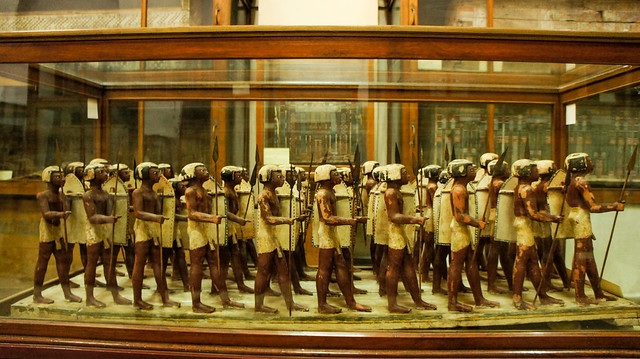
Egyptian warriors figures at the Egyptian Museum of Cairo
Egyptian Pikemen from the Middle Kingdom 

We will meet them again in the post.

Now in December 2015, I took a photo of that group of bronze swords and knives.

Ancient Egyptian swords at the Egyptian Museum of Cairo
Bronze swords at the Egyptian Museum of Cairo 

 Here is also a collection of Ancient Egyptian daggers made of bronze. I found them on the second floor during then.

Tuesday, September 27, 2022

Repatriating the stone: Return back Rosetta stone to Egypt

Egypt celebrates on Tuesday the 200th anniversary of deciphering Ancient Egyptian hieroglyphs and the creation of Egyptology.

Yes, 200 years ago in France, French Jean-François Champollion announced that he succeeded that deciphering the Ancient Egyptian hieroglyphs. That moment created officially Egyptology and archaeology would never become the same.

A replica of Rosetta stone at Egypt's Egyptian Museum of Cairo
A replica of the Rosetta stone at Egypt's Egyptian Museum of Cairo

Champollion would not have done it if it were not for the Rosetta stone or Rashid stone. Found in 1799 by a French officer during Napoleon’s invasion of Egypt at the city of Rashid aka Rosetta, the stone actually contained a decree issued during the Ptolemaic dynasty in three ancient languages: Ancient Greek, ancient hieroglyphs and ancient Demotic language.

Rosetta stone was made from granodiorite in 196 BC, and it is believed that it was displayed at a temple in Sais “in Sharkia governorate” in Nile Delta. It is believed that the stone was transferred during the Mamluk era to be used in the construction of Fort Julien or as commonly known in Egypt as Fort Rashid or Citadel Qaitbey “Not to be confused with the other Citadel Qaitbey in Alexandra”.

It was wide to use ancient stones from ancient Egypt in the construction of buildings like Mosques, schools and forts in the time of the Mamluk era and the examples are many.

The decree inscribed on the stone was issued by a council of priests confirmed the royal cult of Ptolemy V. Egypt is truly the birthplace of the presidential cult

Fast forward to the 19th century and 1801, the English invasion came. 

Monday, March 14, 2022

Kodak Agfa Presents : Luxor’s Deir El-Bahry aka Hatshepsut temple in February 2012 (Part-2)

And we continue our short and quick tour in Hatshepsut Mortuary Temple in Luxor’s Deir El-Bahry in February 2012.

You can refresh your memory and see more about the history of the famous Egyptian Queen’s temple and the history of its excavation as well as the first lower floors or courts in the temple itself in the first part of this two-series post.

On the way to Hatshepsut Mortuary Temple in Deir El-Bahry
On the way to Hatshepsut temple in Deir El-Bahry 

An important disclaimer: I included here only the parts I have seen in this huge complex. There are even more parts that I missed. 

Now to the middle of the second terrace or the court which you reach through a ramp from the lower terrace or court.

Taking a photo at the Middle terrace
The middle terrace of Hatshepsut mortuary temple 

The middle terrace measures 75m deep by 90 m wide according to Wikipedia and it is fronted by colonnades. There are lots of details on this terrace.

Monday, February 14, 2022

Kodak Agfa Presents : Luxor’s Deir El-Bahry aka Hatshepsut temple in February 2012 (Part-1)

This time Kodak Agfa is going to present photos taken from a decade ago and it feels so weird and yet so close!!

I know I am lazy but for my defense, 2012 was among the years full of action in Egypt to the level that amazes me till now.

Anyhow enough of excuses and nostalgia and let’s end that 2012-trip in Luxor and Aswan with the legendary Deir El-Bahry’s site of Hatshepsut Mortuary Temple.

Ascending Hatshepsut Mortuary Temple in Luxor
Hatshepsut Mortuary Temple in Luxor 

It was the last major site I took photos in that short visit in Luxor after the Karnak and Luxor temples.

Friday, December 31, 2021

Egyptian Chronicles’ Movers and Shakers of 2021 “Egypt’s edition”

Welcome to the 2021 edition of Egyptian Chronicles' Movers and Shakers.

It is time of our annual post
Here is my list of those I believe that have been the shakers and movers of 2021 in Egypt.

There will be another list for “Region and world edition”

This is not the list of the top people but rather those who made an impact whether positive or negative based on my own views

This list is without any order. You know me, I write what I remember.

Locally :

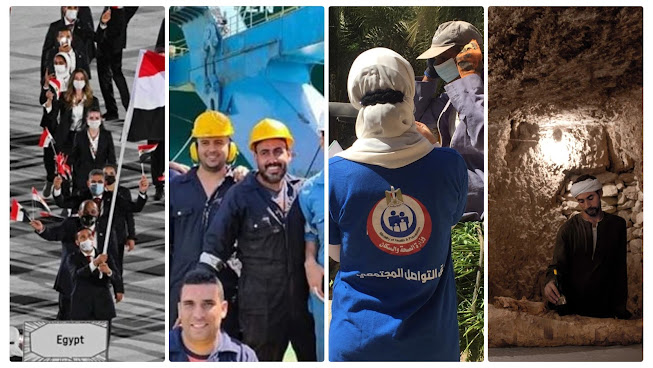
From left to right "Egypt's Olympics delegation, Suez Canal workers, healthcare workers 
and antiquities workers"

A Special Mention

Tuesday, December 14, 2021

Saving Cairo's City of the Dead : The menace to Cairene valley of the Kings is still there

From a couple of weeks ago, many Egyptians received a notification that their family cemeteries will be demolished as part of the government or rather the state’s road extension plan in the Imam Al-Shafie area.

The families were offered small areas for cemeteries as compensation in 15 May city.

The news caught the attention and caused anger among many including myself as aside from the historical importance of this area, it turned out to host the tombs of Egypt’s top figures in the 20th century who shaped this country in the Modern age aside hundreds of normal citizens who deserve to be left alone.

It is like a modern valley of the Kings but prominent figures and commoners both since the Middle ages.

It was a shock to find that late Queen Farida of Egypt was among those unfortunate Egyptians whose family cemeteries are on the demolishment list.

Her family and friends spoke up and the mainstream media covered the issue shyly presenting an opposite view for the government's plan on a couple of two channels.

A rumour spread that the government was going to change the route of this road extension plan but as I hinted it is a rumour and people are back to square one if zero.

As far as I know, engineers and experts presented a number of alternative projects to avoid this area from the city of the Dead altogether.

Cairo's city of the dead
A scene from Cairo's city of the dead "Safeguard of historic Cairo's cemeteries FB"

Some families are planning to sue the government and the governorate in front of the administrative court but I fear it may take time and it will be late.

This brings us to the importance of the long-absent true community dialogue in Egypt.

Known as Cairo city of the Dead, this area has been listed by UNESCO as part of Historic Cairo. 

Thursday, November 25, 2021

Egypt revives the ancient Avenue of Sphinxes in Luxor tonight

In case you do not know, Egypt is on a date on another glitzy ancient Egyptian inspired parade in a few hours.

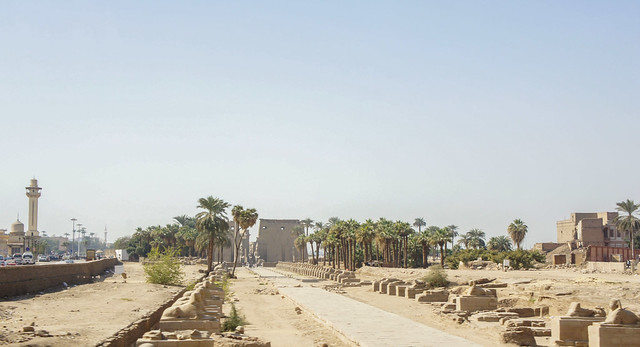
The avenue of the Sphinxes on 24 November's night "Ahmed Gomaa"

The 1.7-mile-long and about 250-feet-wide-Sphinxes Avenue connect the Luxor temple complex and the Karnak temple complex. According to historical accounts, the current surviving sphinxes avenue was built by King Nectanebo I, the founder of Egypt’s last native ruling dynasty aka the 30th dynasty in the late period.

Egypt's Luxor Temples Complex
The Avenue of Sphinxes in 2012

According to archaeologists, most of the sphinxes or rams statues in the avenues have been restored. They are over 1,000 statues. We got four of them in Tahrir square despite the objections of the archaeologists. I wonder why we do not put them back where they belong.

It is said that the face of the sphinxes depicted Nectanebo I in accordance with the famous ancient Egyptian tradition that started in the old kingdom.

The trip to revive the avenue was long starting from year 1984 to 2000 thanks to Egyptian archaeologists then the plan to restore it kicked off in the year 2009 then was stopped for a while in 2011 then it was resumed later till we see right now.

Thursday, November 4, 2021

Kodak Agfa presents : King Tutankhamun at 99

Today marks the national day of Luxor governorate in Egypt. It also marks the discovery of King Tutankhamun’s tomb in the valley of the Kings.

King Tutankhamen's mask at the Egyptian Museum of Cairo
The famous King Tutankamun's mask 

Today marks the discovery of the famous KV62 that turned Egyptology upside down.

Today marks how a simple Egyptian boy stumbled on the tomb of another Egyptian boy who ruled this land from thousands of years ago that some old generals and priests thought that they could rid of him and his dynasty or rather his father’s dynasty forever. Call it fate or destiny or poetic justice but Tut’s story reminds me that history can’t be fooled forever.

King Tut's Golden sarcophagus at the Egyptian Museum of Cairo
King Tut's golden sarcophagus at the Egyptian Museum of Cairo  

Time passed and that young boy became Egypt’s most famous ruler and its symbol worldwide while those who plotted against him, simply forgotten.

Yeah, I am repeating what I have said before.

Thursday, April 22, 2021

Seen in Cairo : Fatima El-Shaqra Mosque in one fine afternoon

And because we are in the heart of historical Islamic Cairo, it was not a big surprise to meet a new ancient mosque in the El-Siyada Zeinab area that gave the scene in Ramadan lanterns market more Ramadan vibe magic.

Fatima El-Shakra Mosque
The minaret of Fatima El-Shaqra Mosque 

This ancient mosque caught my eyes when I was in Bab Al-Khalq for the Ramadan lanterns makeshift markets.

Friday, April 2, 2021

The Golden Pharaohs’ Parade of Egypt

On Saturday, Cairo is on a date with one unique procession.

Cairo will witness a parade of 22 ancient Egyptian Kings and Queens as they or rather their mummies are being transferred from the Egyptian Museum of Cairo in Downtown’s Tahrir Square to the Newly inaugurated The National Egyptian Civilization Museum “NECM” in Old Cairo’s Fustat. 

They are transferred to a new home

They are going to a new home now after more than 100 years in The Egyptian Museum of Cairo as it is undergoing a huge renovation project sponsored by the EU and a bunch of European museums above them the British Museum.

The Mummies are reportedly to receive better and advanced care in the NECM because that care can’t be provided in the Tahrir Museum with its old structure.

The parade will take place at Sunset, at about 6 PM and it will take only 45 minutes but it will be a procession to be remembered. It will start at the renovated Tahrir square. 

The Tahrir square after renovation "Egyptian Cabinet"
The Tahrir square after renovation "Egyptian Cabinet" 

Those kings and queens from the Modern Kingdom's 17th, 18th, 19th and 20th dynasties were discovered in the 19th and early 20th centuries at the Valley of the Kings in Luxor.

They are: King Seqenenre TaaQueen Ahmose Neferati,King Amenhotep IQueen Merit AmunKing Thutmose IKing Thutmose II,  Queen HatshepsutKing Thutmose IIIKing Amenhotep IIKing Thutmose IVKing Amenhotep IIIQueen TiyeKing Seti IKing Rameses II, King MerenpathKing Seti IIKing SiptahKing Ramesses III, King Ramesses VKing Ramses IVKing Ramses VIRamesses IX

The mummies of the 18 kings and 4 queens will be carried on special vehicles with their names inscribed on them.